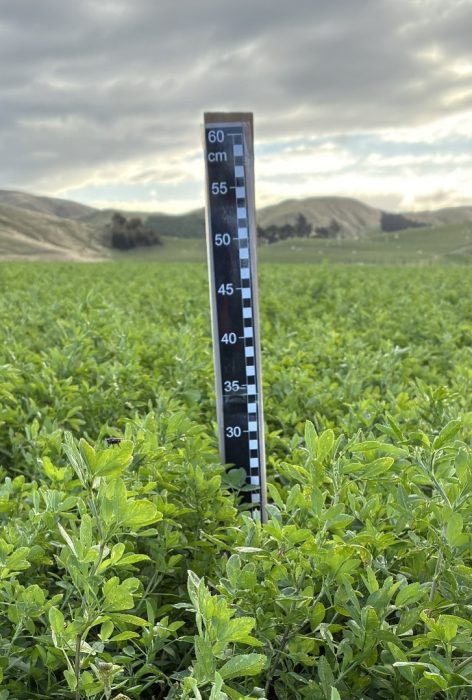
The “Phosphorus and Lucerne Project” is funded by the Ellett Agricultural Research Trust and the Marlborough Research Centre and will run for three years from July 2025 to November 2028.
Milestones | Researchers | Outputs
What are we doing?
The six on-farm experiments installed for this project replicate the Lincoln University Iversen 5 experiment that found lucerne growing on a soil with a low Olsen P of 5 mg/L continued to be highly productive for four+ years and non-responsive to annual superphosphate fertiliser treatments of 0, 50, 100, 200 or 400 kg/ha.
Aim: Assess the impact of phosphorous fertiliser on lucerne biomass at on-farm sites in Canterbury and Marlborough
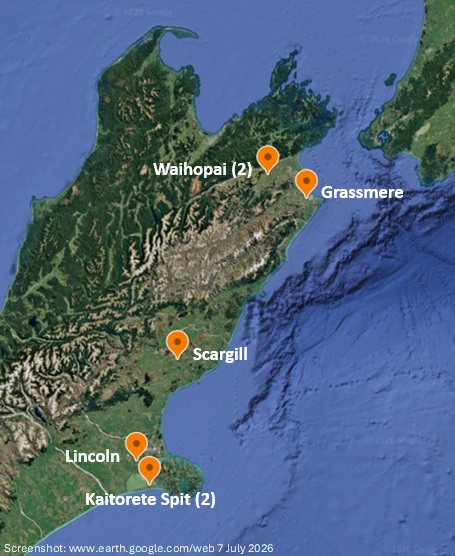
Location of on-farm experiments
In addition to the original Lincoln site, the six new experiments are in Marlborough and Canterbury covering a range of soil types, initial Olsen P values (8 to 25 mg/L), lucerne cultivars, and lucerne ages.
Milestones
- Install on-farm experiments in Marlborough and Canterbury (Year 1)
- Monitor lucerne yield, herbage quality, and herbage P% in response to superphosphate rates throughout three growing seasons (2025 to 2028) and report findings annually (Years 1 to 3)
- Conduct onsite field days (Year 2)
- Produce a research paper (Year 3)
Researchers
- Derrick Moot, Head of Dryland Pastures Research
- Sonya Olykan, Research Officer
- Jason Nolan, Research Technician
- Annamaria Mills, Senior Research Officer
Students
- Mia Jones (Masters 2026 – current)
- Carys Luke (PhD 2026 – current)
Outputs
Yearly reports – executive summary
| 30/06/2026. Year 1 Executive Summary for the Phosphorus and Lucerne Project. 2 p. (PDF 0.5 MB) |  |
Journal publications
- Jones, L., Mills, A. and Moot, D. 2025 Spring growth of lucerne (Medicago sativa L.) after different winter grazing regimes. Journal of New Zealand Grasslands, 87, 255–261.
Thesis/Dissertations
- (in progress)
Project funders