Posted on behalf of Prof Derrick Moot
The end of September is when the evapotranspiration exceeds rainfall at Lincoln. We start losing the stored soil water. I asked Jason to look at our neutron probe data from the RADE experiment to see where we are at this year compared with previous ones. Things are dry – despite another 15 mm of rain falling on Sunday – but not as dry as 2024 (Figure 1). We have ~230 mm of plant available water to 2.0 m in the RADE. With an average moisture loss of ~3.0 mm in October and 4.0 mm in November we should get to the end of November with the soil water we have. Of course, hot drying Nor’westers could increase those evapotranspiration rates so we will monitor conditions as spring develops. For now, the highest growth rates of all pastures are about to occur with warmer and lengthening days but still cold nights which shuts downs respiration and gives us our highest water use efficiency and radiation use efficiency at this time of year.
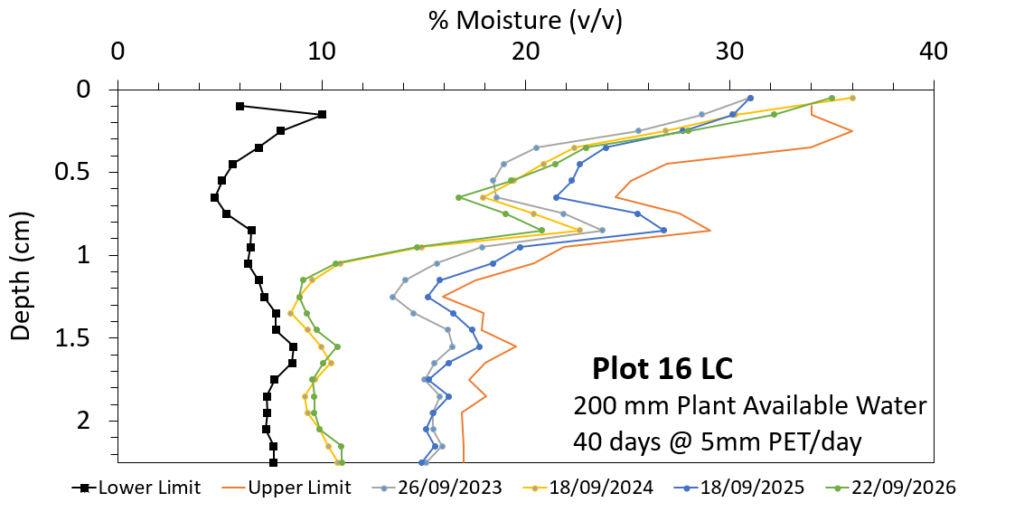
Figure 1. Comparison of soil water content in early spring of 2023, 2024, 2025 and 2026 in Plot 16 of the RADE experiment at Lincoln University, New Zealand. Graph produced by Jason Nolan (Lincoln Iniversity).
I was in Central Otago last week and the issue of soil moisture also came up. They are about to start lambing as spring temperatures rise…one issue we discussed was when to plant lucerne. Some farmers had been using the text service to think that early October is the target – that is ok for Lincoln. But for them it isn’t. Soil moisture can be conserved via a fallow of sprayed out ryecorn with 4-6 weeks to build up moisture. Soil temperature needs to be 10 °C before drilling in late November/early December. Their concern was that the soil moisture would disappear – but evapotranspiration only occurs if there are actively growing plants in the soil that have roots that pipe water from depth to the atmosphere. By fallowing, either using a stale seedbed or chemically spraying out the paddock with glyphosate, spring moisture can be held and used to germinate seeds.
The key requirement is to roll after sowing – the soil is dry so compression will increase soil to seed contact and diffusion will draw moisture from depth to the surface 20 mm where the seed germinates. If the soil is too fluffy and then we roll and get rain there is a risk of capping – so the soil surface conditions dictate whether a Cambridge roller or heavy roller are needed. The aim of the stale seed bed in Central Otago is to see if there are horehound seedlings that can then be dealt with before drilling – or going through another summer of weed control. Just over the hills in Southland – there is too much soil water. They are experiencing their wettest spring for 40 years.
There is not much you can do when things are so wet. Every time you move animals you create mud, soil temperatures are low, so pasture growth is low, ewes get muddy and everybody is miserable hoping for sunshine to dry things out. No-one knows what El Nino will bring, and it will be different in different regions of NZ, as it always is. The main aim of farming during this period is to know what is happening to soil moisture so there are levers to pull if it gets drier – or wetter – than normal. Our aim is to provide systems that can cope with whatever comes – resilience requires flexibility.
